
Midterm Election Years: A Biblical View of Markets
Share This Insight
Do not be anxious about anything, but in every situation, by prayer and petition, with thanksgiving, present your requests to God. And the peace of God, which transcends all understanding, will guard your hearts and your minds in Christ Jesus.
— Philippians 4:6-7 (NIV)
Election years can make uncertainty feel more urgent.
A client recently asked, “I am worried about this November. Should we do something with my portfolio before the election?”
This is an understandable concern. Political campaigns naturally emphasize what is at stake. Add inflation, interest rates, global conflict, and economic headlines, and investors may feel pressure to act.
The 2026 midterm elections will take place on November 3. Every House seat and roughly one-third of the Senate will be contested.
These elections matter for public policy, but election forecasts should not drive a long-term financial plan.
The market is non-partisan
Investors often feel more optimistic when their preferred party is in office. History, however, suggests that political preference is a poor foundation for investment decisions.
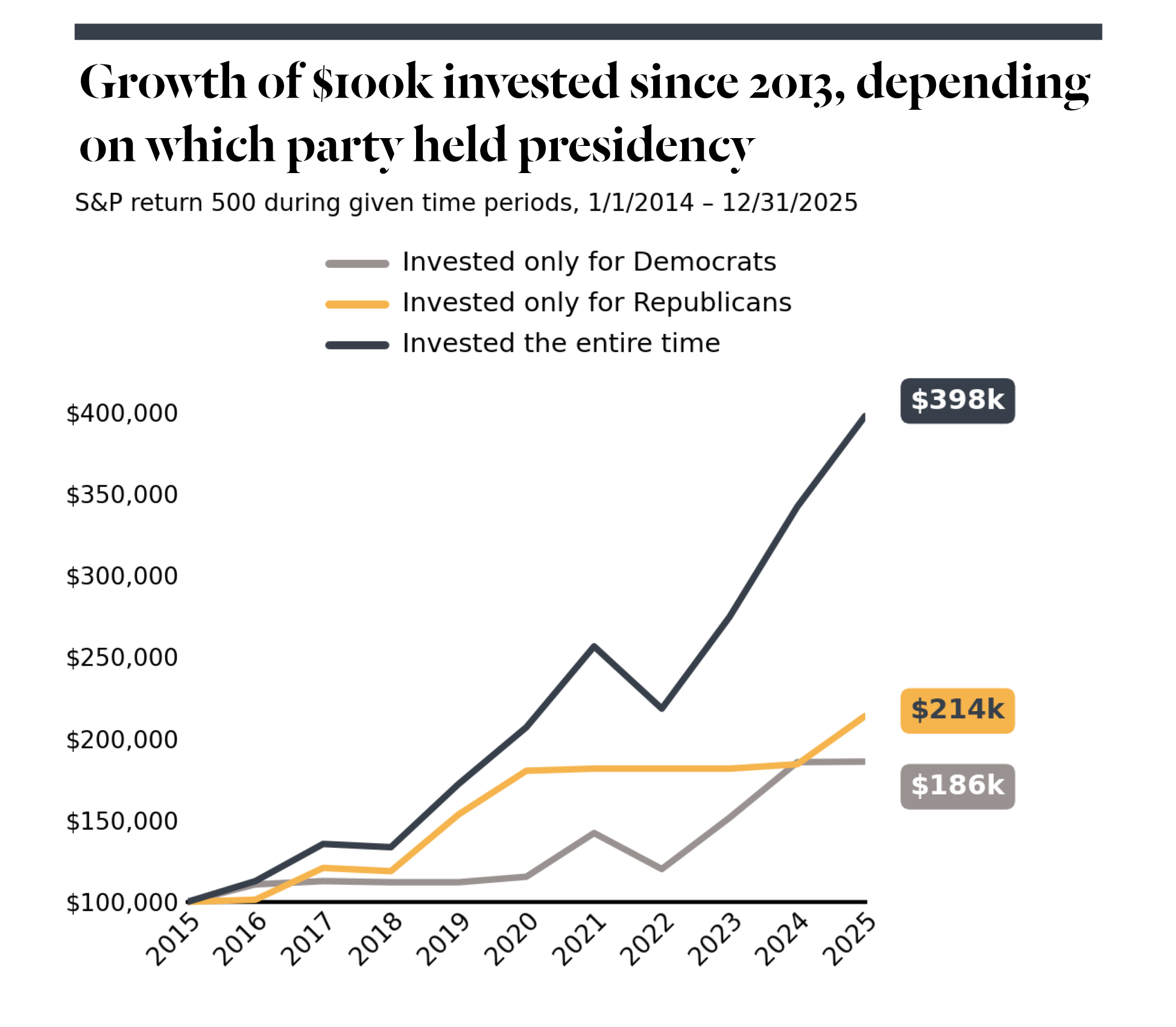
Historical and hypothetical results show that remaining invested produced stronger outcomes than investing only when one political party held the presidency. Source: BlackRock and Morningstar.
Over the past decade (above) and the past century (below), individuals who remained continuously invested accumulated substantially more than individuals who participated only under Democratic or Republican presidents.
Policies matter, but moving in and out of the market based on politics has historically meant missing meaningful periods of growth.

We can vote according to our values and convictions without allowing politics to become the driver of our investment decisions.
Midterm years have historically produced lower returns
Midterm election years have often been less rewarding than other years of the election cycle.
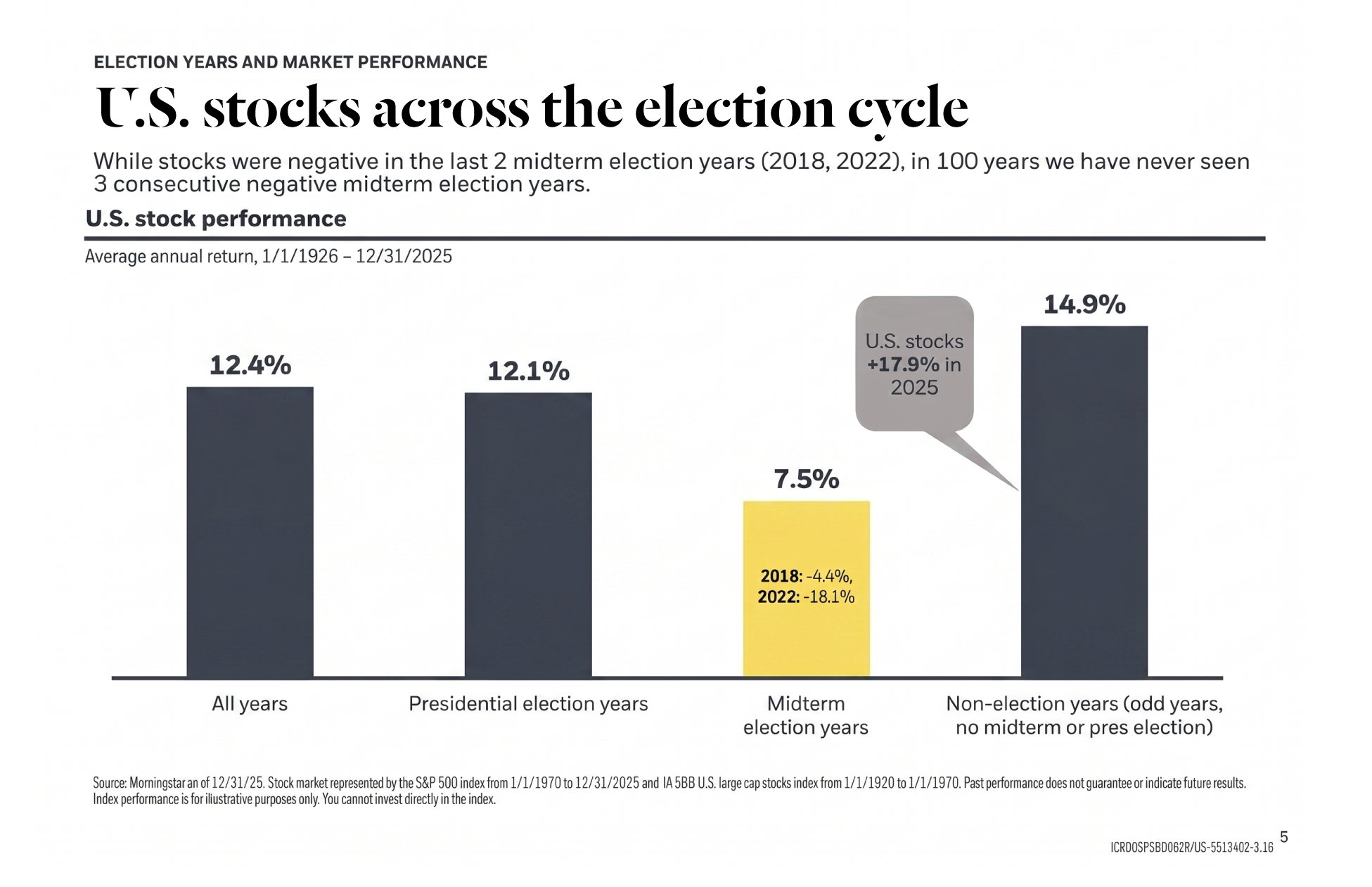
From 1926 through 2025, U.S. stocks returned an average of 7.5% during midterm election years, compared with 12.4% across all years. Source: BlackRock and Morningstar.
The two most recent midterm years, 2018 and 2022, were negative. Yet those declines occurred in very different economic environments and should not be attributed to elections alone.
Inflation, interest rates, earnings, economic growth, and global events generally matter far more than the political calendar.
Midterm years can follow an uneven path
Annual returns alone do not show the ups and downs that investors experienced along the way throughout these midterm election years.
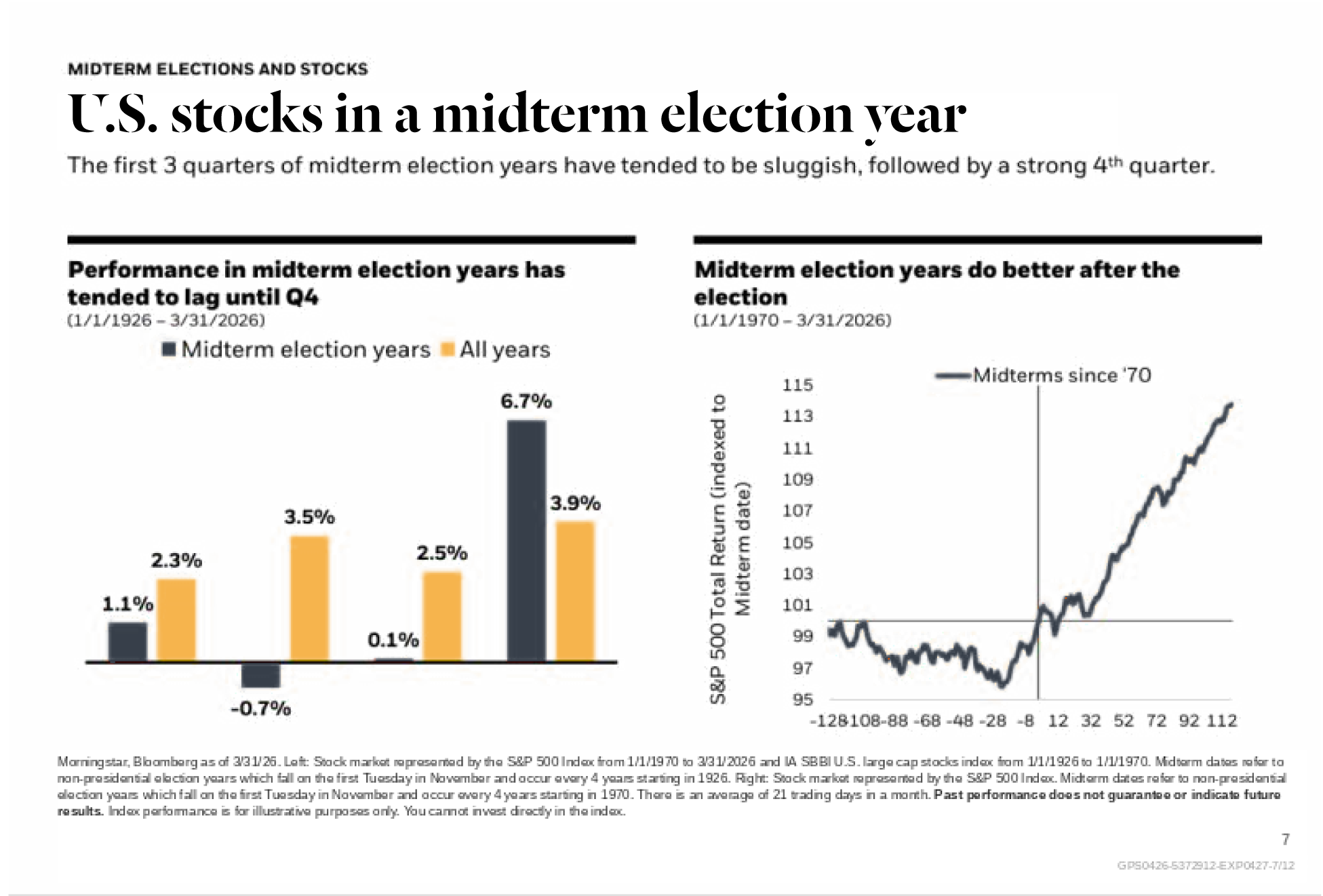
Midterm election years have historically followed a more uneven path, often weakening through the summer and early fall before improving later. Source: Blackrock, Bloomberg, and Morningstar.
The average midterm year has historically lagged other years for much of the calendar year, specifically in the first three quarters. That helps explain why these periods can feel uncomfortable, even when the full-year result is positive.
It’s important to realize that historical averages provide context, not a forecast. No individual year should be expected to follow the same pattern.
For instance, this year, the market was down 4.6% in Q1, up 14.8% in Q2, and as of July 31, it is about flat for Q3, totaling a 9.7% YTD return. This is dramatic outperformance relative to historical averages from mid-term election years.
Large daily moves have been limited so far
We often describe volatility by counting how frequently the market moves at least 2% in a single day.
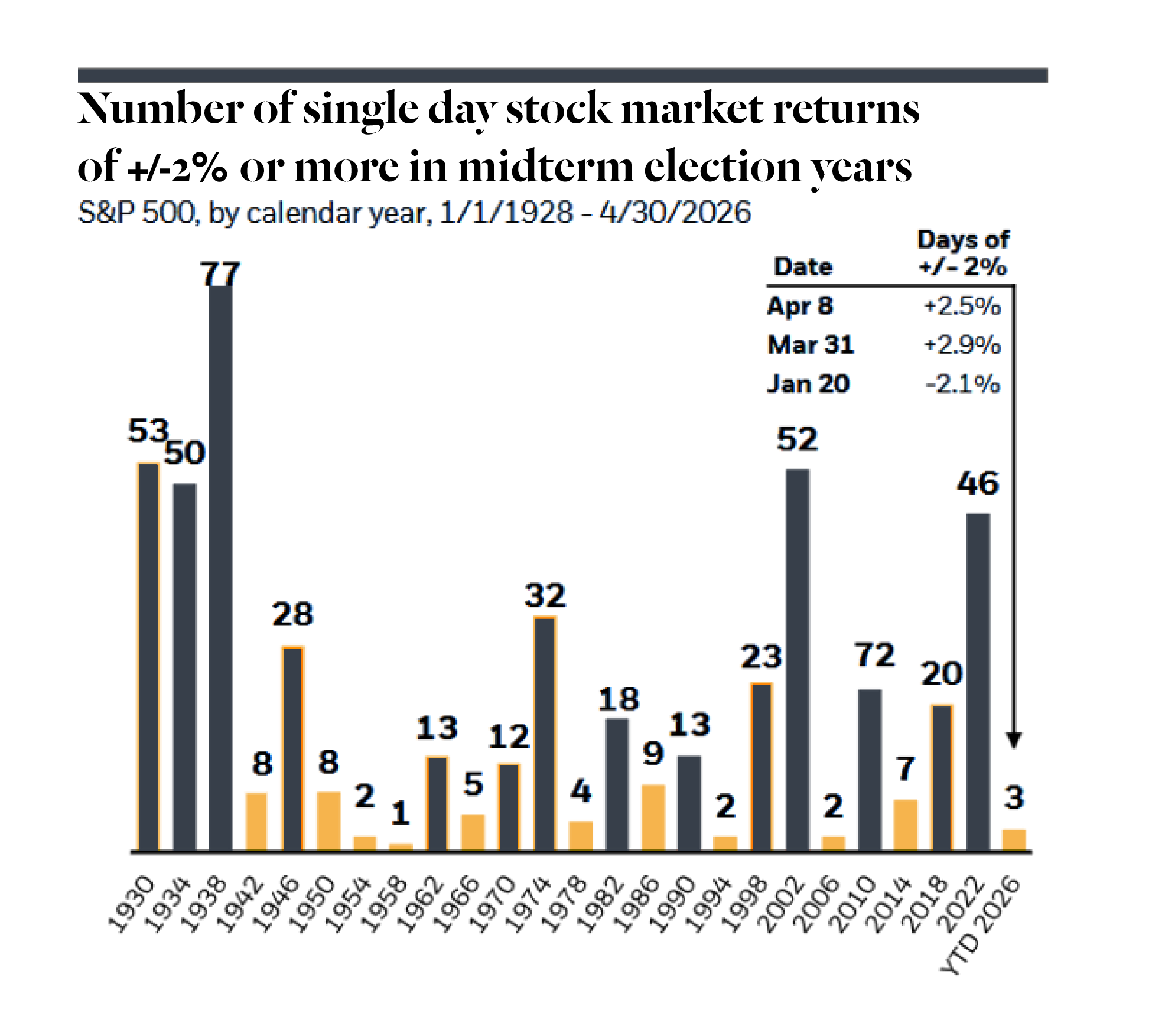
Through July 21, 2026, the S&P 500 had experienced four trading days with moves of at least 2% in either direction. Source: BlackRock, Morningstar, and Koyfin.
Through July 31, this year has seen relatively few large daily moves compared with many previous midterm years.
That does not mean volatility will remain low. Economic data, interest-rate expectations, earnings, political developments, or global events could produce larger swings later in the year.
The number of large daily moves is descriptive, not predictive. It is a helpful indicator of the overall market environment, but it is not a market-timing signal.
The period after midterms has historically been stronger
Although midterm years have produced lower average returns, the 12 months following midterm elections have historically been stronger.

From 1950 through 2023, the S&P 500 returned an average of 15.4% during the 12 months following midterm elections, compared with 7.8% in other years. Source: LPL Research.
Red bars = Republican President; blue bars = Democrat President
Source: LPL Research, Capital Group, RIMES, Standard & Poor’s 01/15/26.
This does not mean the market will rise after the 2026 election. Each cycle is different.
The more useful lesson is that markets often improve before investors feel confident. This gives us one of our investment principles: Don’t miss the recovery. By the time the news feels reassuring, much of the recovery may already have occurred.
A temporary decline does not determine the year
Market declines are uncomfortable, but they are also normal.

Source: Blackrock and Bloomberg.
Many positive years included double-digit declines along the way. A difficult month or quarter does not necessarily mean a long-term plan has failed.
Instead of asking only what the market might do next, consider:
- Does my plan still reflect my goals?
- Is my portfolio aligned with my time horizon and risk tolerance?
- Do I have enough cash reserves for near-term needs?
- Am I letting emotions or political biases influence my investment choices?
These questions keep financial decisions grounded in wisdom rather than fear.
Let your plan be your guide, not your politics.
Biblical stewardship does not require us to predict every market move. It calls us to be diligent, patient, and faithful with the resources entrusted to us.
Proverbs 21:5 contrasts thoughtful planning with hasty action: “The plans of the diligent lead to profit as surely as haste leads to poverty.” (NIV)
A sound financial plan should be built to endure multiple elections, economic cycles, market declines, and recoveries. Changes in family circumstances, goals, income needs, taxes, or risk tolerance may justify a review. Political uncertainty alone usually does not.
As the 2026 election approaches, stay informed as a citizen, vote according to your convictions, and evaluate your finances according to your long-term plan. Most of all, as 1 Timothy 2:1 reminds us, pray for all who are in high positions, no matter the party affiliation.
If market volatility or the election has caused you to question whether your investment strategy still fits your plan, the John Moore Associates team would be glad to help you review it.
Subscribe for More Financial Insights
Never miss a post. Receive notifications by email whenever we post a new JMA Insight.