Year-End Financial Planning Checklist: Finishing 2026 with Intention
Share This Insight
A year-end financial planning checklist helps you finish the year with intention. Before December 31, review your tax picture, confirm required minimum distributions (RMDs), finalize charitable gifts and revisit your investment portfolio. Then take time to reflect on how your family stewarded its resources. JMA clients should submit year-end requests by the deadlines below.
As December approaches, many of our clients begin asking the same question: “Is there anything I still need to take care of before year-end?”
Between holiday gatherings and family commitments, it’s easy to overlook important financial planning deadlines. A simple year-end financial planning checklist can help.
At John Moore Associates, we believe wise financial planning is an act of stewardship. 1 Corinthians 4:2 reminds us, “Moreover, it is required of stewards that they be found faithful.” (ESV)
That means being intentional with what God has provided, including the financial decisions we make as the year comes to a close.
Here are five areas worth reviewing before December 31.
1. Review Your 2026 Tax Picture
By December, most families have a clearer understanding of their income, capital gains, and potential tax liability for the year.
That makes it an important time to review opportunities such as:
- Roth conversions
- Tax withholding
- Capital gains management
- Retirement distributions
- Charitable contributions
We encourage families to coordinate these conversations with their JMA planning team and CPA.
Taxes matter. But they are one part of a larger picture. The goal is to make thoughtful decisions that align with your broader financial plan.
2. Review Required Minimum Distributions
Required minimum distributions primarily affect retirees age 73 and older. However, they may also apply to individuals with inherited IRAs, depending on whom they inherited the account from and when it was inherited.
For most individuals already taking RMDs, distributions must be completed by December 31. Missing a required distribution can result in penalties, so confirming these are completed is an important step. For JMA clients, the request deadline is December 23.
Don’t Overlook Qualified Charitable Distributions (QCDs)
For charitably inclined individuals age 70½ or older, Qualified Charitable Distributions (QCDs) can be a particularly valuable planning opportunity.
A QCD allows you to direct funds from your IRA to a qualified charity, potentially satisfying all or part of your RMD while excluding the eligible distribution from taxable income.
For those already planning to give, this can be a meaningful way to combine tax planning with generosity.
Remember that QCDs must go directly to eligible charities. Donor-advised funds, including National Christian Foundation (NCF) Giving Funds, do not qualify as QCD recipients.
3. Finalize Charitable Giving Before the Deadlines
For many families, year-end generosity is one of the most meaningful parts of financial planning. Whether you’re supporting your church, a favorite ministry, or another charitable organization, year-end is a great time to carry out your giving plan.
As I already mentioned, retirees can utilize QCDs, but donating appreciated investments rather than cash may offer certain tax advantages, depending on your circumstances.
Important Changes to Charitable Deductions in 2026
Beginning in 2026, taxpayers who take the standard deduction may also deduct up to $1,000 ($2,000 for married couples filing jointly) in qualifying cash contributions to eligible charities.
For taxpayers who itemize, charitable deductions are generally subject to a new threshold of 0.5% of adjusted gross income before the donations can be deducted. There is also a new charitable deduction cap for families in the 37% federal income tax bracket.
These changes make it especially important to consider when and how you make charitable contributions.
For clients with their Giving Funds at NCF, certain gifts may require additional processing time, so we encourage planning ahead.
Our encouragement is simple: Don’t wait until December 31 to begin the process.
4. Revisit Your Investment Portfolio
Year-end is also an important opportunity to review your investment portfolio and look for potential tax-planning opportunities.
After several strong years in the markets, many families may have higher-than-normal realized capital gains. If that’s the case, consider reviewing your portfolio for investments with unrealized losses that may be harvested to offset some of those gains. This is often called tax-loss harvesting.
You may also have capital loss carryforwards from previous years that could help offset current gains.
Beyond taxes, it’s worth reviewing whether your portfolio remains aligned with your long-term goals, risk tolerance, and upcoming financial needs.
Not every review requires making changes. The objective is to remain intentional rather than react to short-term market movements.
5. Reflect on Your Stewardship
Finally, I encourage you to look beyond your investments and tax documents.
- How did your family steward its resources this year?
- Were you able to support the people and causes that matter most?
- Are there opportunities to be more intentional in 2027?
These conversations can also be an opportunity to involve children and grandchildren in discussions about generosity, responsibility, and the purpose of wealth.
At JMA, we believe wealth is a tool, not an end goal. Faithful stewardship means making thoughtful decisions about what we’ve been given and how those resources can serve others.
Common Questions About Year-End Financial Planning
Here are a few questions we often hear from clients this time of year.
When Should I Start Thinking About Year-End Planning?
Now is a good time. Our first request deadline is December 9 for Roth conversions, and many year-end steps depend on paperwork, trade settlement, and coordination with outside institutions. Reaching out early gives our team time to do this well.
When Does My RMD Need to Be Taken?
For most people already taking RMDs, by December 31. To give our team time to process it, please submit your RMD request by December 23.
Can I Send My QCD to My NCF Giving Fund?
No. QCDs must go directly from your IRA to an eligible charity, and donor-advised funds, including NCF Giving Funds, do not qualify. If you’d like to add to your Giving Fund this year, we can talk through other ways to do that.
How Much Can I Give Through a QCD This Year?
Up to $111,000 per person for 2026, based on the IRS inflation adjustment. A QCD can count toward all or part of your RMD, and the eligible amount is excluded from taxable income. Depending on your circumstances, it may be one of several ways to give from your IRA.
Let’s Finish the Year Well
There is still time to be intentional about your year-end financial planning. If you began an annual review during Financial Planning Month, year-end is a natural time to finish it.
One important scheduling note: Most of our team will be working remotely during the final two weeks of December, and some team members will be taking time off for the holidays. We encourage you to reach out early so we have sufficient time to coordinate your requests.
If you haven’t reviewed your required distributions, charitable giving plans, tax considerations, or investment portfolio, we’d welcome the opportunity to walk alongside you. Reach out to your JMA team anytime, or if we haven’t met yet, we’d be glad to schedule a time to talk.
As we close 2026, my hope is that we approach the coming year with gratitude for God’s provision and wisdom in how we steward it.
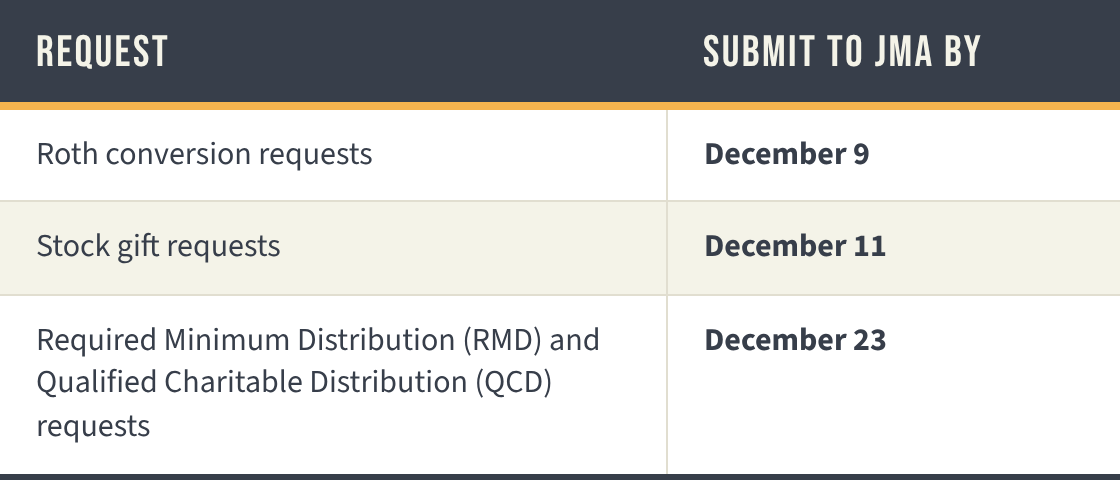
JMA Year-End Request Deadlines for 2026
To allow sufficient time for year-end processing, we ask that you submit the following requests to our team by these dates:

Requests received after these dates will be handled on a best-efforts basis.
Processing times may vary depending on paperwork requirements, trade settlement, and coordination with outside institutions.
While we cannot guarantee completion by year-end, submitting your requests by these dates gives our team the opportunity to coordinate the necessary steps.
Important Disclosures: This article is for general educational purposes only and does not constitute individualized investment, tax, or legal advice. Consult your financial advisor and tax professional regarding your circumstances. Investments involve risk, including possible loss of principal. Tax-loss harvesting involves specific tax considerations, including wash-sale rules. Processing deadlines may change, and timely submission does not guarantee completion or particular tax treatment. Additional firm disclosures may apply.
Subscribe for More Financial Insights
Never miss a post. Receive notifications by email whenever we post a new JMA Insight.